
You’ve been seeing someone for a while.
You know their coffee order. You know the story they always tell when they’re nervous. You probably know which side of the bed they prefer, even if you haven't officially discussed anything that sounds remotely that serious.
Your weekends have started filling up with each other.
Then a friend casually asks, “So, are you two together?”
And suddenly you're doing mental maths on your last six dates.
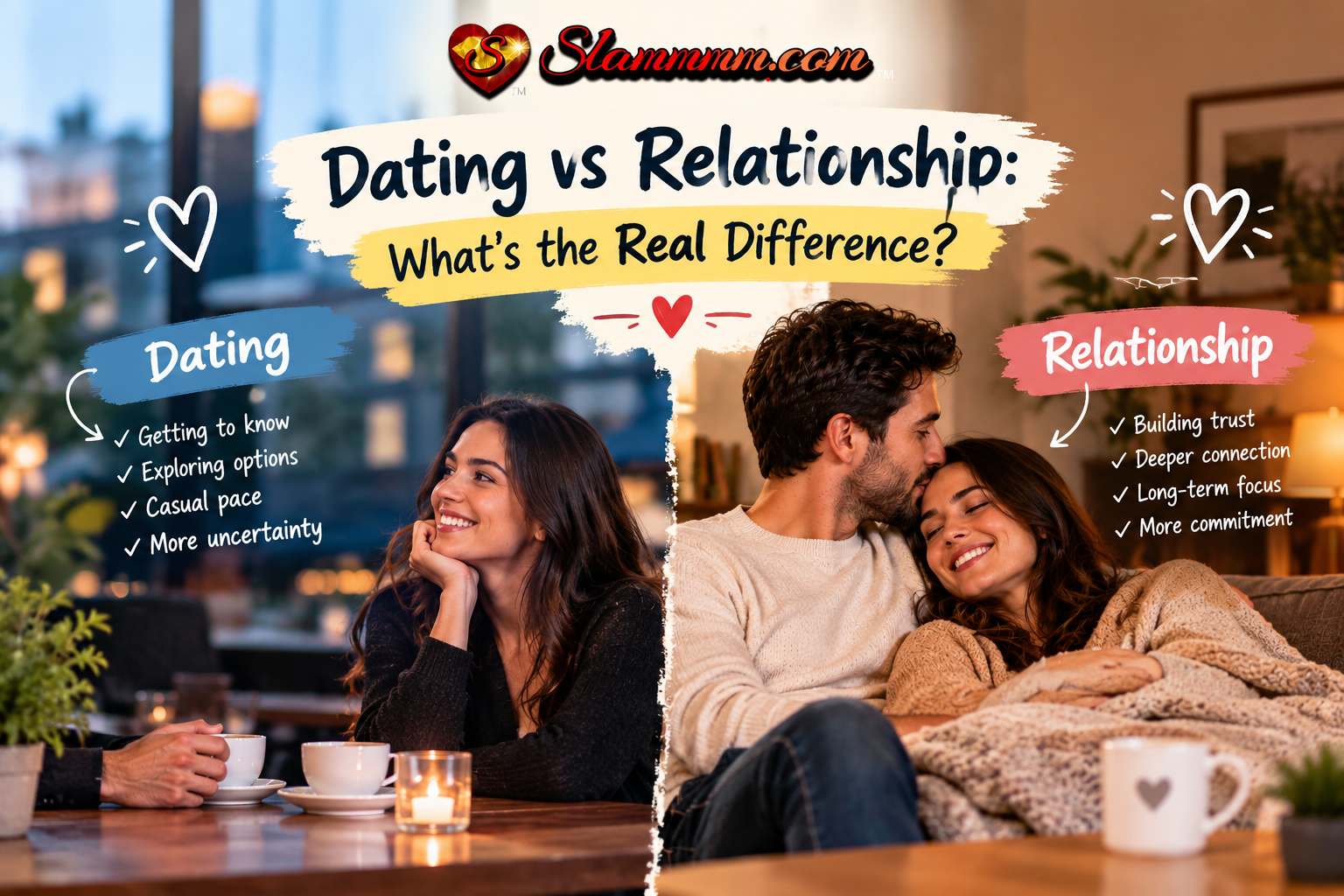
There isn't a magic number that answers the question. Dating usually means you're getting to know someone and seeing whether the connection has somewhere to go. A relationship involves a clearer decision from both people to invest in that connection, often with some understanding of commitment or exclusivity.
The uncomfortable part?
Two people can behave like a couple for weeks and still have completely different ideas about what they're doing.
That's where the dating vs relationship difference actually matters.
Dating Doesn't Automatically Turn Into a Relationship
There is no relationship fairy who appears after date number seven with paperwork, and no single moment that marks the difference between dating and relationship status.
Some couples become exclusive after a few weeks. Others take months. Some people know almost immediately that they want something serious. Others need time to figure out whether the person they enjoy dating is also someone they want in their everyday life.
So instead of counting dates, look at what has changed.
Maybe you used to make plans around your existing schedules and now you're automatically checking what the other person is doing that weekend.
Maybe they know about the presentation you're nervous about next Thursday.
Maybe you have a charger permanently living at their place.
Maybe you've started discussing a concert three months from now without either of you finding that remotely strange.
Those things can signal that the connection is becoming more important. They don't, however, establish a relationship by themselves. That part still requires two people to agree on what they're doing.
Dating vs Relationship: What Actually Changes?
The simplest dating vs relationship comparison comes down to shared expectations.
| Dating | Relationship |
|---|---|
| You're getting to know each other | You're intentionally building a connection |
| You're exploring where things could go | You've decided to invest more seriously |
| Exclusivity may still be unclear | Exclusivity is usually discussed or agreed upon |
| You're learning each other's expectations | You have a clearer idea of what you expect from each other |
| You're seeing how you fit together | Your decisions increasingly take each other into account |
These aren't strict rules.
Someone can be exclusive and still describe themselves as dating. Another couple might call themselves a relationship before they've had a formal “what are we?” conversation.
Labels matter because they communicate expectations. But the label alone doesn't create the relationship.
The conversation does.
If you think you're casually dating while the other person believes you're already committed, you've got a much bigger problem than finding the right word for your relationship status.
Talking, Dating, and Being in a Relationship Aren't Quite the Same Thing
The “talking stage” is usually where things get especially fuzzy.
You're messaging. Maybe you're flirting. You're sending each other things that remind you of inside jokes that don't technically exist yet. You're interested enough to keep checking your phone, but nobody has quite said what this is.
Then you start meeting in person.
That's dating.
You're finding out what this person is like away from their carefully chosen texts and profile pictures. You learn how they treat waitstaff, how they handle an unexpected change of plans, whether conversation flows when there's no screen between you.
A relationship comes later if both people decide they want something more committed and have some shared understanding of what that means.
The stages can overlap. They can move quickly. They can stall.
And sometimes you date someone for a while and decide you don't want a relationship with them.
That's not a failed timeline. That's dating doing its job.
You're Dating. So What Signs Actually Tell You Where It's Going?
Sometimes the dates themselves aren't confusing.
It's everything that happens between them.
Saturday was great. You laughed for hours. They kissed you goodbye and said they'd see you soon.
Then Monday arrives.
Nothing.
Now you're staring at your phone trying to determine whether “see you soon” meant Wednesday or some vague point in the future when the planets align.
One delayed text isn't particularly useful information. Neither is one enthusiastic message.
Look at the pattern.
- Do they make plans with you, or do you always make them?
- Do they remember things you've told them?
- Do they make room for you in their week?
- Are conversations becoming more personal?
- Are you both putting effort into keeping the connection moving?
Consistency tells you considerably more than one text.
There is another catch, though: someone can genuinely like you and still not be ready for a relationship. They might be busy. They might have recently come out of something serious. They might simply want to date casually.
You can't reliably diagnose any of that from punctuation, response times, or whether they watched your story.
At some point, you have to ask.
Dating vs Situationship: Where Does That Line Get Blurry?
Casual dating can be surprisingly straightforward.
You like each other. You spend time together. You enjoy what you have without promising something you're not ready to give.
A situationship becomes harder to read when the behaviour starts looking like a relationship while the expectations remain undefined.
- You text every morning.
- You see each other every weekend.
- You've met their friends.
- You know the family stories.
- You have a favourite restaurant.
One person thinks, We're basically together.
The other thinks, We're having fun. Why are we making this complicated? Neither person is necessarily doing something wrong.
The problem is the mismatch.
A situationship isn't automatically unhealthy. Two people can genuinely prefer keeping things casual or undefined.
It becomes painful when one person is quietly building expectations around a future the other person never agreed to.
That's when “going with the flow” starts feeling suspiciously like avoiding a conversation.
When Should You Ask, “What Are We?”
Forget the three-month rule.
Forget date number ten.
Forget whatever timeline a stranger on TikTok says you're supposed to follow this week.
Ask when the uncertainty starts affecting how you behave.
Maybe you're getting attached and don't know whether they feel the same.
Maybe you're wondering if you're still free to date other people.
Maybe you're making plans for next month and feel strange assuming they'll still be around. Or maybe you're spending more time analysing their texts than enjoying the person you're actually dating.
That's usually enough reason to talk.
And it doesn't need to sound like a corporate performance review.
Try: “I'm really enjoying spending time with you. I'd like to know how you're feeling about where this is going.”
That's a conversation.
It isn't a marriage proposal.
They might want something serious. They might need more time. They might want to keep things casual.
You may not love the answer.
It's still better than inventing one yourself.
Liking Someone Isn't the Same as Being a Good Fit
Chemistry can make incompatibility surprisingly easy to ignore, one of the trickier parts of relationships and dating in general.
At first, it doesn't matter that one person wants every weekend packed with plans while the other considers staying home and ignoring the outside world until noon a perfect Saturday.
Then real life starts showing up.
One person wants to talk through an argument immediately. The other needs an hour alone first.
One loves having friends over every weekend. The other needs warning before anyone enters the house.
One thinks saving for a big trip is exciting. The other thinks spending the money now sounds much more fun.
None of those people is wrong.
They may simply be difficult people to build a life with if neither can accommodate the other.
While you're dating, pay attention to things like:
- Communication: Can you disagree without turning every disagreement into a fight?
- Lifestyle: Do your everyday routines leave enough room for each other?
- Relationship intentions: Are you looking for roughly the same kind of commitment?
- Social life: Can you have different interests without constantly trying to change each other?
- Effort: Does keeping the connection going feel mutual?
You don't need to find your personality twin.
You do need enough common ground that ordinary life together sounds appealing.
That's one reason dating can be useful even when it doesn't lead to a relationship. You're learning more than whether you're attracted to someone.
You're learning what being around them actually feels like.
What If You're Still Guessing Whether They Like You?
This is one of the stranger parts of modern dating.
You know you like them.
You just don't know how much they like you.
The date goes brilliantly. You're laughing together on Saturday night. Then their replies get shorter on Monday.
So you decide not to text first.
They don't text either.
Now two people who were having a great time 48 hours ago are both trying very hard to look completely unbothered.
It's exhausting.
And it's one area where having more information about mutual interest can be useful.
SLAMMMM's Love DiamondTM is designed to give users insight into changing levels of interest, rather than leaving the early stages entirely to message timing and guesswork. It doesn't decide whether two people belong together. You still have to talk, meet, disagree, laugh, and spend enough actual time together to figure that out.
The Interests feature adds another piece by helping people spot shared interests and potential common ground.
That distinction matters.
Technology can't create chemistry between two people who don't have it. It can, however, help make some of the uncertainty around early interest easier to navigate.
So, What Matters More: The Label or the Understanding Behind It?
The label is useful.
“Dating.” “Exclusive.” “Relationship.” “It's complicated.” We have plenty of words for this stuff.
But two people using the same label can still want very different things.
A couple might call themselves exclusive while one person assumes marriage is eventually on the table and the other has no intention of getting married.
Another couple might avoid the word “relationship” for months while behaving with complete honesty and commitment toward each other.
So when you're trying to understand your dating vs relationship status, ask yourself a more practical question:
Do we both understand what we're doing here?
If the answer is yes, the label becomes much easier.
If the answer is no, that's probably the conversation you need to have.
Dating Is the Part Where You Find Out
Dating isn't just the waiting room before a relationship. It's the part where you collect information.
- Do you enjoy talking to this person when there's nothing particularly exciting happening?
- Can you handle small disagreements?
- Do you like the way they treat other people?
- Do your ideas about commitment line up?
- Are you both interested enough to keep showing up?
Those answers matter more than the number of dates you've been on.
A relationship starts making sense when the two of you aren't simply enjoying the connection anymore; you've started making a shared decision about continuing it.
And that decision doesn't have to happen on anyone else's schedule.
Frequently Asked Questions
Q1. What is the difference between dating and a relationship?
Dating is generally the stage where two people are getting to know each other and exploring a romantic connection. A relationship involves a clearer mutual decision to invest in that connection, usually with more defined expectations around commitment.
Q2. Can you be dating someone without being in a relationship?
Yes. Two people can date, enjoy spending time together, and still be figuring out whether they want an exclusive or committed relationship.
Q3. At what point does dating become a relationship?
There is no universal number of dates or weeks. It becomes a relationship when both people agree that they want a more committed connection and have a shared understanding of what that means.
Q4. Does kissing mean you're in a relationship?
No. Kissing can show attraction or affection, but it doesn't automatically establish exclusivity or relationship status.
Q5. What's the difference between dating and a situationship?
Dating can be casual or serious, but the people involved generally understand that they're exploring a romantic connection. A situationship tends to become confusing when the closeness and behaviour resemble a relationship while the expectations or commitment remain unclear.
Q6. What is the 3-3-3 rule for dating?
The 3-3-3 rule is an informal dating guideline rather than a proven relationship formula. Different versions exist, but the basic idea is to use certain stages or time periods as opportunities to evaluate how a connection is progressing. There is no universal dating timeline that works for every couple.